Advice on Choosing a College
There are 4 categories of colleges that I would consider and I'll address the pros and cons of each.
- Introduction
- Elite private universities
- Your flagship state university
- Private colleges in the area you plan to live after graduation
- Other public schools in your home state
- Summary
My brother recently went through the process of applying to and selecting a college (he chose the University of Minnesota-Twin Cities!) and my sister is applying this year. I thought I would pass on the advice I gave to them.
First, graduate from high school--the U.S. high school graduation rate is ridiculous. It's not that difficult.
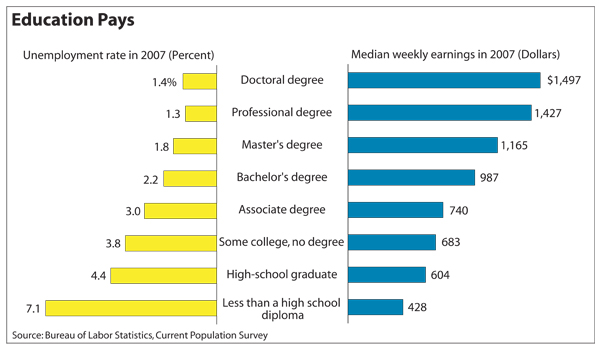
Second, go to college. If you're not sure if college is for you--go anyway. It doesn't matter what you want to be when you grow up--every career can benefit from a college education. Also, keep in mind that your career will change with time and there is never a better time to go to college than now. And, keep this chart from bls.gov in mind:
Money
College is an investment. The above chart shows the returns but doesn't show how much each education level costs. According to this article the average student loan debt for 2006 graduates was about $21,000. That balance on a 10-year loan at 6.8% would equate to monthly loan payments of $241.67 and, according to finaid.org, you would need an annual salary of at least $29,000 to afford it. To put this into perspective, starting salaries for computer science graduates averaged $53,000 per year (source). Of course, psychology majors from an expensive school might have a tough time. The payoff depends on the job you get and the job you get depends on your major. But choosing a major is the subject of another page. The bottom line is that college is a great investment if you choose your college based on the job you expect after graduation.
You can get a good idea of which schools are considered the most prestigious by looking at the U.S. News rankings. There is a strong correlation between these rankings, cost, selectivity, and reputation for quality. Most of these schools are fairly large with a wide range of majors--of course, you should verify that the school offers the major(s) you're interested in before applying.
There are several downsides to applying to elite colleges. First, they're extremely selective. This article says "Harvard turned down 1,100 students with perfect...SAT math" scores, "Yale rejected several applicants with perfect 2400" on the SAT. In addition, the environment is often very competitive and high-pressure. Still, a degree from these schools carries a lot of weight and as college admissions get more selective, that value is likely to continue to increase. You'll notice that a disproportionately high number of high-level executives at large companies, lawyers at top firms, medical researchers, and even professors at other elite institutions received degress from elite private universities.
I specifically mention private universities since typically "out of state" public schools charge nonresident tuition that is comparable to private universities. With few exceptions, I wouldn't consider an out-of-state public school.
Your flagship state university
Inevitably, your home state's flagship university is a fine institution, is known around the country, and offers reasonable in-state resident tuition. Also, they often offer almost any major you can think of. The downside is that these schools are usually huge--however, when you get to the upper division classes in the competitive majors, the classes are more reasonably sized. Best of all, despite dramatic increases in recent years, resident tuition at most state universities is one of the best bargains in college education.
One other note: some states offer "reciprocity" between states. For example, students from Minnesota or Wisconsin can attend either the University of Minnesota or the University of Wisconsin and pay resident tuition.
Private colleges in the area you plan to live after graduation
Private colleges are nice because the professors are committed to teaching and they typically have small class sizes. The downsides are that they are generally more expensive than in-state public schools and they usually have fewer majors to choose from. Most of them are "liberal arts" colleges that emphasize greater breadth but less depth when compared to public universities, in general.
A downside to the small size of most private schools is that they are typically not known outside of the local area. For example, my alma mater of Augsburg College in Minneapolis, Minnesota has a great reputation in the twin cities of Minneapolis and Saint Paul but few people outside of Minnesota have heard of it. That's why I emphasize "in the area you plan to live after graduation".
Other public schools in your home state
The non-flagship public universities in most states are good options for those who aren't planning a competitive career and/or don't have the best high school record and want a college that provides a good value. They're generally not regarded as highly as the flagship university, so they aren't the best choices for those considering applying to top graduate schools. Of course, some states, especially California, have several top-tier public universities.
To summarize, if you're planning to choose a competitive major and career, I would recommend applying to elite colleges, your flagship state university, and private colleges in the area you plan to live after graduation. If you're choosing a career with lower or uncertain earning potential, I would recommend your flagship or other state universities and perhaps private colleges in the area you plan to live after graduation.
I would absolutely recommend applying to a range of schools. If I was going through the process again, I would apply to a few elite schools such as Carnegie Mellon and Northwestern; my local flagship university, the University of Minnesota-Twin Cities, and, with tuition reciprocity, the University of Wisconsin-Madison; as well some private schools in Minnesota like Augsburg College, Carleton College, St. Thomas University, and Macalester College. Actually, I would apply to a bunch more than that--why not? I would probably apply to 4 or 5 elite schools, the 2 public schools mentioned, and another 4 or 5 smaller private schools. There's just a small cost (of time and application fee) for each additional application. One benefit of applying to a large number of schools is that you can get vastly different financial aid packages seemingly randomly and you can use one school's financial aid offer to negotiate for a better package at another school.
Once you've given yourself a lot of options, you ultimately need to choose the school that feels right to you. And don't stress out over it too much--your success will depend on how hard you work much more than what college you choose.